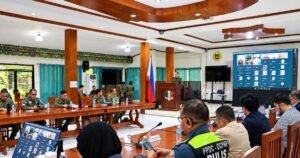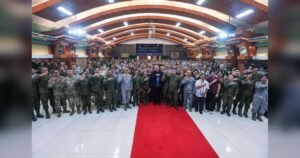
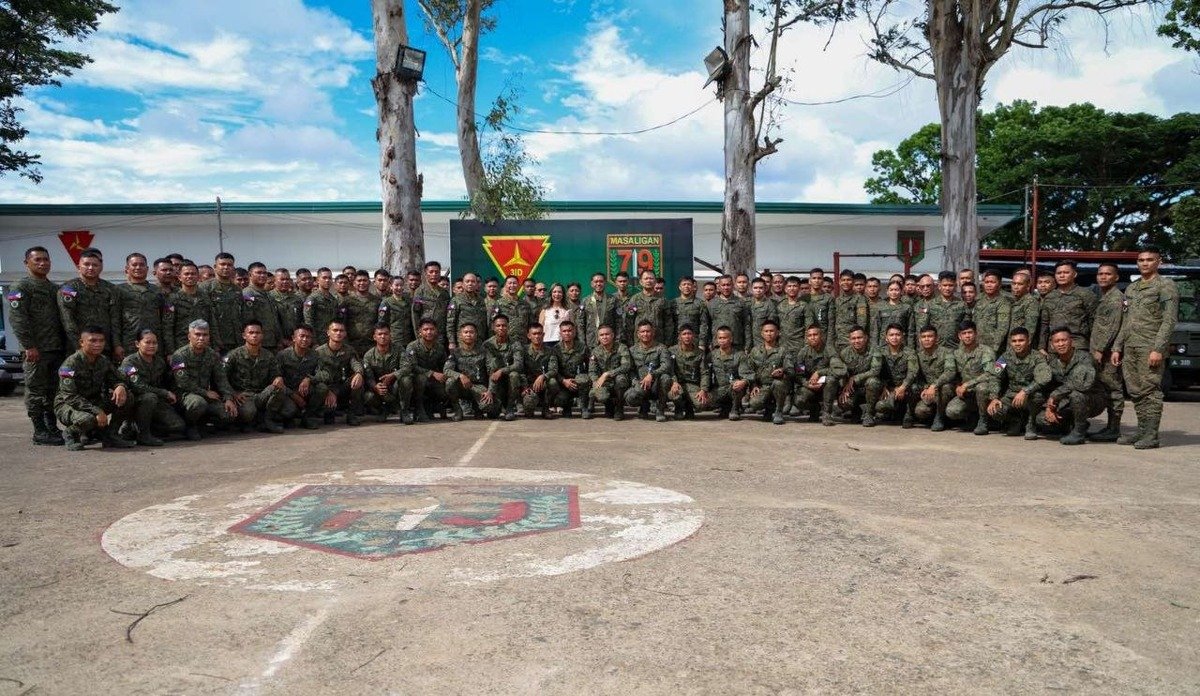
Armed Forces of the Philippines Chief of Staff General Romeo S. Brawner Jr. made a personal appearance at the headquarters of the 79th Infantry “Masaligan” Battalion on May 2, traveling to Barangay Bato in Sagay City, Negros Occidental to formally recognize the unit’s recent battlefield success against Communist New People’s Army terrorists operating in the municipality of Toboso.
The visit drew senior military leadership together, with 3rd Infantry “Spearhead” Division Commander Major General Michael G. Samson accompanying the AFP chief. Battalion Commanding Officer Lieutenant Colonel Eric Alfonso received the delegation at the unit’s headquarters, where General Brawner addressed assembled troops in a formal ceremony.
Top Military Brass Commends Masaligan Troopers
Standing before the men and women of the 79th Infantry Battalion, General Brawner delivered remarks that touched on both operational achievement and the military’s broader mandate. His appearance in itself served as a strong signal of how the AFP leadership views the battalion’s contributions to peace and order in Negros Occidental.
“This visit is both an opportunity to commend your steadfast service and to reaffirm our shared commitment to securing lasting peace in your area of responsibility,” the AFP chief said during the ceremony, as quoted by the AFP Public Affairs Office.
Beyond praising the soldiers’ courage and discipline, General Brawner underscored the necessity of keeping operational momentum alive. He framed the ongoing counter-insurgency effort not merely as a series of tactical engagements, but as a sustained campaign with long-term implications for entire communities living under the shadow of armed threat.
The general described the campaign against communist terrorists as “not just a military effort, but a collective stand of communities choosing progress over fear” — a characterization that reflects how AFP leadership conceptualizes the fight against the NPA as inseparable from civilian welfare and development.
Toboso Operation Draws National-Level Attention
The high-level visit was directly tied to the outcome of a recent operation conducted against Communist NPA Terrorists in Toboso, Negros Occidental. Although specific operational details were not made public in the official military statement, the decision by the AFP chief himself to travel to the unit’s headquarters is considered a strong indicator of the strategic weight assigned to the engagement.
The 79th Infantry Battalion has maintained an active operational posture across its area of responsibility in Negros Occidental, with several municipalities falling within its coverage where military intelligence has recorded documented NPA activity. Lieutenant Colonel Alfonso’s command has coordinated closely with local government officials and community stakeholders to address security threats before they escalate.
The battalion’s nickname “Masaligan” — a word that evokes dependability and trustworthiness — reflects its institutional identity as a unit that local communities can rely on. That reputation appears to have been further reinforced by the Toboso operation’s outcome.
Momentum Must Be Maintained, Brawner Tells Troops
A central theme of General Brawner’s address was the danger of complacency following tactical success. While acknowledging the significance of recent gains, he urged the Masaligan Battalion to remain vigilant and mission-focused rather than treat a single successful operation as a definitive turning point.
“Recent gains must be sustained through continued commitment to service and strong community partnership to ensure enduring peace and development,” he told the troops, laying out what amounts to a strategic blueprint for the unit’s continued operations in the region.
This emphasis on sustainability reflects a matured understanding within the AFP that battlefield victories, while necessary, are insufficient on their own to permanently dismantle insurgent networks. Preventing the NPA from regrouping, reinfiltrating communities, or simply shifting operations to adjacent areas requires an enduring presence and constant community engagement.
3rd Infantry Division’s Expanding Footprint in Visayas
The 3rd Infantry “Spearhead” Division, which Major General Samson commands, provides oversight for military operations across a wide section of the Visayas. Its constituent units, including the 79th Infantry Battalion, have played a pivotal role in rolling back NPA influence in areas that were previously considered reliable staging grounds for the communist insurgency.
Major General Samson’s decision to accompany the AFP chief on this visit underscores the division-level significance attached to the battalion’s performance. It also signals that the 79th Infantry Battalion’s approach — combining direct military action with civil-military operations — aligns with the broader operational doctrine being applied across the division’s area of responsibility.
The 3rd Infantry Division has pursued what military planners describe as a multi-pronged strategy: kinetic operations against armed insurgents on one hand, and softer civil-military programs — covering infrastructure, livelihood assistance, and education — on the other. The goal is to address the socioeconomic conditions that communist groups exploit when seeking to recruit from marginalized communities.
Why Community Partnership Matters in Counter-Insurgency
The AFP’s persistent emphasis on forging genuine partnerships with civilian communities is grounded in decades of operational experience. Military doctrine has evolved considerably from approaches that relied predominantly on armed force, toward strategies that recognize the political and social dimensions of insurgency as equally important battlegrounds.
General Brawner’s phrase about communities “choosing progress over fear” is not merely rhetorical. It points to a deliberate effort to present government forces as enablers of civilian welfare, rather than simply armed actors pursuing insurgents. When communities see tangible benefits from cooperating with government — improved infrastructure, economic opportunities, access to services — the NPA’s recruitment pipeline and intelligence network weaken considerably.
This community-centered model involves sustained coordination between the military, local government units, non-governmental organizations, and community leaders. The aim is to preemptively address the grievances that insurgent groups weaponize in their propaganda and recruitment efforts.
Broader Significance for Negros Occidental’s Security Landscape
The Toboso operation and its subsequent recognition at the highest levels of AFP command are meaningful developments for Negros Occidental, a province that has experienced fluctuating levels of insurgent activity over several decades. Recent operational gains represent a continuation of the military’s effort to permanently reduce NPA presence on the island.
Security analysts monitoring the region note that sustained pressure from well-coordinated units like the 79th Infantry Battalion makes it increasingly difficult for NPA elements to consolidate, resupply, or recruit. Success in Toboso may also carry lessons applicable to other units engaged in similar counter-insurgency missions in other parts of the country.
On an institutional level, General Brawner’s visit also serves an important morale function. By personally traveling to the battalion headquarters and publicly acknowledging the soldiers’ sacrifices and achievements, the AFP chief reinforces a command culture that rewards operational excellence — potentially strengthening unit cohesion and mission commitment across the wider command structure.
Photo credit: SSg Ambay PA / PAOAFP